Unusual Award N.13- Extreme Gluteal Proportions In African Woman Jun 2026

1: Analysis

Unusual Award N.13- Extreme Gluteal Proportions In African Woman Jun 2026

: By framing her responses as prestigious awards, Ekezie uses sharp wit to highlight how Western media and individuals often dehumanize or exoticize African bodies and culture.

Even after her death in 1815, her remains were dissected, and her skeleton and brains were displayed at the Paris Musée de l'Homme until 1974. Her story remains a stark symbol of colonial exploitation, the dehumanization of Black women, and the roots of scientific racism. Thanks to a campaign led by President Nelson Mandela, her remains were finally returned to South Africa for a dignified burial in 2002.

Following the end of apartheid, South African President Nelson Mandela formally requested the return of Saartjie Baartman’s remains from France. : By framing her responses as prestigious awards,

Fat deposits concentrate specifically in the gluteal region.

The historical documentation of extreme gluteal proportions in African women includes dark chapters of exploitation, most notably the story of . Thanks to a campaign led by President Nelson

Behind the humor and viral hashtags lies a deep history involving genetics, evolutionary biology, and cultural perceptions of full-figured bodies across the African continent. This article explores the biological reality of steatopygia, the impact of colonial history, and the modern reclamation of the African female form. Understanding the Biology: What is Steatopygia?

Charity Ekezie has built a massive following on TikTok by "schooling" viewers who ask ignorant or stereotypical questions about Africa—such as whether Africans have seen water or if they live in trees. "Award N.13" became a fan favorite because it flipped a common fetishizing search term into a tool for social commentary. Cultural Impact creating a distinctive

The Objectification of Saartjie Baartman: The History Behind "Unusual Award N.13"

In historical anatomical encyclopedias, variations that did not align with classical Greco-Roman proportions were often labeled as "anomalies" or "curiosities." Medical illustrators and ethnographers would assign numbers or specific classifications to these traits, creating a literal index of human diversity. The Impact of Objectification

Ultimately, "Unusual Award N.13- Extreme Gluteal Proportions In African Woman" serves as a case study in how modern internet subcultures subvert historical trauma. By taking clinical, highly problematic imagery and turning it into a running online joke, African creators successfully reclaim their bodies, their narratives, and their joy. Share public link

Steatopygia is not merely obesity or weight gain in the lower body; it is a specific build where the fat deposition is not confined to the gluteal region but extends to the outside and front of the thighs, creating a distinctive, curvilinear figure. Interestingly, research suggests that this trait might have been more widespread in the ancient world. Paleolithic Venus figurines, discovered across Europe and Asia, often display remarkably developed thighs and prominent buttocks, leading scholars to speculate that steatopygia may have been a common characteristic in Upper Paleolithic populations or highly valued in ancient fertility cults.
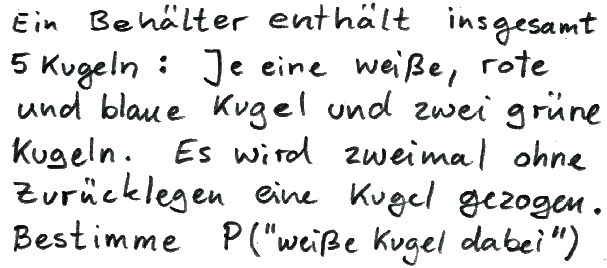
2: Stochastik


2.1: Grundbegriffe

2.1.1: Pfadregeln
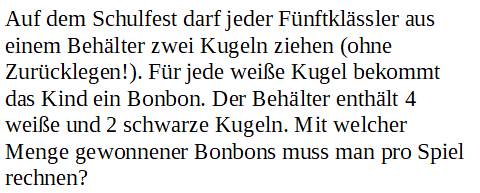
2.1.1.1: Aufgabe (Niveau EF*) - Lösung   --  [Direktlink]
scanpic 
2.1.2: Mittelwert, Erwartungswert, Standardabweichung
2.1.2.1: Aufgabe (Niveau EF**) - Lösung   --  [Direktlink]
scanpic 
2.1.2.2: Aufgabe (Niveau EF*) - Lösung   --  [Direktlink]
scanpic 

2.2: Bedingte Wahrscheinlichkeiten

2.2.1: Vierfeldertafel
2.2.1.1: Aufgabe (Niveau EF**) - Lösung   --  [Direktlink]
scanpic 
2.2.1.2: Aufgabe (Niveau EF**) - Lösung   --  [Direktlink]
scanpic 
2.2.1.3: Aufgabe (Niveau EF**) - Lösung   --  [Direktlink]
scanpic 
2.2.1.4: Aufgabe (Niveau EF**) - Lösung   --  [Direktlink]
scanpic 

2.3: Verteilungen

2.3.1: Binomialverteilung
2.3.1.1: Aufgabe (Niveau Q2*) - Lösung   --  [Direktlink]
scanpic 
2.3.1.2: Aufgabe (Niveau Q2*) - Lösung   --  [Direktlink]
scanpic 

2.4: Testen (LK)

2.4.1: Hypothesentests (LK)
2.4.1.1: Aufgabe (Niveau Q*) - Lösung   --  [Direktlink]
scanpic 

3: Vektoren


3.1: Rechnen mit Vektoren

3.1.1: Addition/Subtraktion, Multiplikation mit einer Zahl
3.1.1.1: Aufgabe (Niveau Q*) - Lösung   --  [Direktlink]
scanpic 
3.1.1.2: Aufgabe (Niveau Q) - Lösung   --  [Direktlink]
scanpic 

3.2: Geraden und Ebenen

3.2.1: Geraden und Ebenen aufstellen
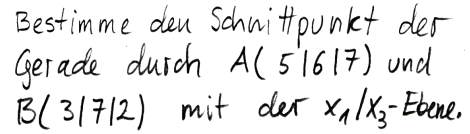
3.2.1.1: Aufgabe (Niveau Q) - Lösung   --  [Direktlink]
scanpic 
3.2.1.2: Aufgabe (Niveau Q) - Lösung   --  [Direktlink]
scanpic 
3.2.1.3: Aufgabe (Niveau Q*) - Lösung   --  [Direktlink]
scanpic 
3.2.1.4: Aufgabe (Niveau Q) - Lösung   --  [Direktlink]
scanpic 
3.2.1.5: Aufgabe (Niveau Q) - Lösung   --  [Direktlink]
scanpic 
3.2.2: Lagebeziehungen (nur Parameterformen)
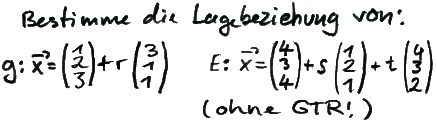
3.2.2.1: Aufgabe (Niveau Q) - Lösung   --  [Direktlink]
scanpic 
3.2.2.2: Aufgabe (Niveau Q) - Lösung   --  [Direktlink]
scanpic 
3.2.2.3: Aufgabe (Niveau Q) - Lösung   --  [Direktlink]
scanpic 
3.2.3: Koordinatenform der Ebene (und Umwandlungen)
3.2.3.1: Aufgabe (Niveau Q) - Lösung   --  [Direktlink]
scanpic 
3.2.3.2: Aufgabe (Niveau Q) - Lösung   --  [Direktlink]
scanpic 
3.2.3.3: Aufgabe (Niveau Q*) - Lösung   --  [Direktlink]
scanpic 
3.2.4: Abstandsprobleme (für den Leistungskurs)
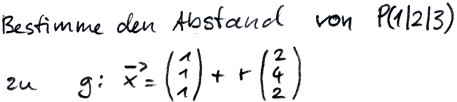
3.2.4.1: Aufgabe (Niveau Q*) - Lösung   --  [Direktlink]
scanpic 
3.2.4.2: Aufgabe (Niveau Q*) - Lösung   --  [Direktlink]
scanpic 
3.2.4.3: Aufgabe (Niveau Q*) - Lösung   --  [Direktlink]
scanpic 
3.2.4.4: Aufgabe (Niveau Q*) - Lösung   --  [Direktlink]
scanpic 
3.2.4.5: Aufgabe (Niveau Q*) - Lösung   --  [Direktlink]
scanpic 
3.2.4.6: Aufgabe (Niveau Q*) - Lösung   --  [Direktlink]
scanpic 

3.3: Vermischte Aufgaben

3.3.1: Vermischte Aufgaben
3.3.1.1: Aufgabe (Niveau Q*) - Lösung   --  [Direktlink]
scanpic 
3.3.1.2: Aufgabe (Niveau Q*) - Lösung   --  [Direktlink]
scanpic 
3.3.1.3: Aufgabe (Niveau Q**) - Lösung   --  [Direktlink]
scanpic 
3.3.1.4: Aufgabe (Niveau Q*) - Lösung   --  [Direktlink]
scanpic 


Erzeugt: 2026-02-28-17:06:02


Kurze Erklärung zu den Niveau-Angaben:
Basis: Fähigkeiten, die in der Oberstufe vorausgesetzt werden.
EF: Fähigkeiten, welche im Laufe der EF gelernt werden müssen.
Q: Fähigkeiten, welche im Laufe der Qualiphase gelernt werden müssen.

Daneben werden noch Sternchen vergeben:
Kein Sternchen: Einstiegsaufgaben ("zum Laufen lernen")
Ein Sternchen: Einfaches bzw. normales Niveau ("muss man können, um keine 5 zu bekommen")
Zwei Sternchen: Anspruchsvollere Aufgaben ("Hab' ich's wirklich verstanden?")